Towing isn't just about hitching up a trailer and hitting the road. It's a complex dance of physics and engineering, where understanding your vehicle's Towing Capacity & Performance Benchmarks is the ultimate key to a safe, efficient, and stress-free journey. Whether you're hauling a boat to the lake, lugging a camper for a family getaway, or moving heavy equipment for work, getting the numbers right isn't just smart—it's non-negotiable.
When you're dealing with thousands of pounds behind your truck, every metric, from engine torque to brake fade, plays a critical role. Ignoring these benchmarks risks not only costly vehicle damage but also serious accidents. This guide will cut through the jargon, empowering you with the knowledge to tow confidently, safely, and powerfully, every single time.
At a Glance: Your Towing Takeaways
- Know Your Numbers: Gross Combined Weight Rating (GCWR), Gross Vehicle Weight Rating (GVWR), Payload Capacity, and Tongue Weight are your towing commandments.
- Weight Matters: Never exceed manufacturer specifications; they're set for your safety and vehicle longevity.
- Balance is Key: Proper load distribution within the trailer and correct tongue weight prevent dangerous sway and poor handling.
- Brakes & Power: Account for significantly increased braking distances and ensure your engine has ample horsepower and torque to manage the load.
- Gear Up: Invest in the right hitches, brake controllers, sway control, and other accessories for enhanced safety and peace of mind.
- Practice Makes Perfect: Get comfortable with your combined rig before hitting the open road, especially in varied conditions.
Deciphering the Numbers: Your Towing ABCs
Before you even think about connecting a trailer, you need to speak the language of towing. These core ratings define the absolute limits of what your vehicle can safely handle. Ignoring them is like building a skyscraper without checking its foundation.
Gross Combined Weight Rating (GCWR): The Grand Total
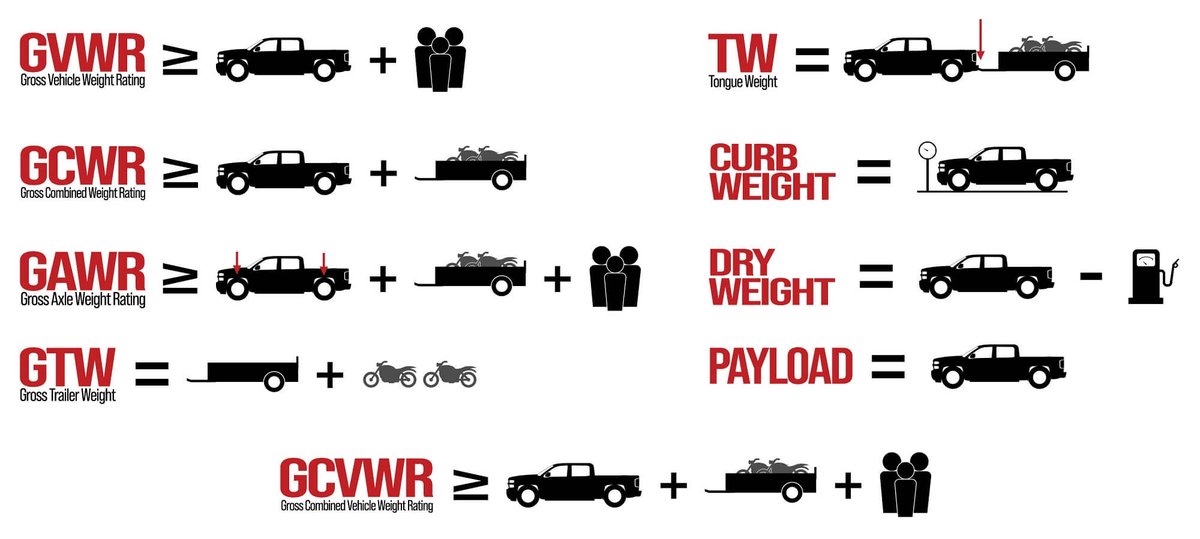
Think of the GCWR as the maximum allowable weight of your entire rolling convoy: your truck, the trailer, every passenger, all your cargo, and even the fuel in the tank. Manufacturers painstakingly calculate this figure, taking into account everything from engine power and cooling systems to transmission strength and braking capabilities.
Exceeding the GCWR isn't just a suggestion; it's a direct threat to your vehicle's health and your safety. It overstresses the engine and transmission, compromises braking ability to a dangerous degree, and significantly increases your risk of an accident. And here's a crucial point: fancy aftermarket modifications might make your truck feel tougher, but they do not change the manufacturer-set GCWR. That number is etched in stone for a reason.
Gross Vehicle Weight Rating (GVWR): What Your Truck Bears
While GCWR is about the entire package, GVWR zeroes in on your tow vehicle itself. This rating represents the total weight your truck can safely carry, including its own curb weight, the weight of all passengers, any cargo in the bed or cabin, and crucially, the downward force of the trailer on the hitch, known as tongue weight.
Imagine loading up your truck bed with camping gear and a few friends, then adding a heavy trailer. If the combined weight of all that — plus your truck's own weight — exceeds the GVWR, you're risking severe suspension damage, premature tire wear, and incredibly unsafe driving conditions, especially around corners or bumps. Remember, the GVWR applies to what the truck itself can safely support, distinct from the overall mass it can pull.
Payload Capacity: Your Cargo Allowance
Often confused with towing capacity, payload capacity is simpler: it's the maximum weight your truck can carry inside its cabin and bed. This includes you, your passengers, all your gear, tools, groceries, and yes, the ever-important tongue weight from your trailer.
Understanding your payload capacity is vital. If your trailer has a tongue weight of 800 lbs, that 800 lbs counts directly against your truck's payload capacity. Overloading your payload can lead to dangerous handling issues, reduced braking effectiveness, excessive wear on your suspension components, and even a sag in the rear that lifts the front wheels, compromising steering.
Tongue Weight: The Critical Downward Force
The "tongue weight" is the downward pressure your trailer exerts on your truck's hitch. It's arguably one of the most critical factors for stable towing. Ideally, your tongue weight should fall within 10-15% of your trailer's total loaded weight.
- Too Low: If your tongue weight is too light (less than 10%), the trailer's rearward weight distribution will lift the rear of your tow vehicle, leading to a phenomenon known as "fishtailing" or severe trailer sway. This is incredibly dangerous, especially at speed or in crosswinds, and can quickly lead to loss of control.
- Too High: Conversely, if your tongue weight is too heavy (more than 15%), it can excessively depress the rear of your truck. This might lighten the front wheels, impairing steering and braking, and place undue strain on your truck's rear axle, tires, and suspension.
Achieving the correct tongue weight ensures your trailer tracks smoothly behind your vehicle, maintaining stability and predictable handling. Investing in a simple tongue weight scale is a small price to pay for significant peace of mind.
Weight Capacity: Your Truck's Maximum Pull
This is the number most people think of when they talk about "towing capacity"—the maximum load your vehicle can safely pull without compromising performance or safety. This figure is primarily derived from your truck's GCWR and is a direct indication of what the manufacturer deems safe.
Exceeding your truck's weight capacity is a recipe for disaster. It can lead to decreased traction (especially uphill), significantly poor braking performance, engine overheating, transmission failure, and potential structural damage to your vehicle. Always, always, always consult your manufacturer’s specifications, typically found in your owner's manual or on a sticker inside the driver's side door jamb.
Calculating Your Real-World Towing Capacity
The published "towing capacity" on a brochure often assumes an ideal, stripped-down truck with only a lightweight driver. To find your actual, usable towing capacity, you need to do a little math:
- Start with your truck's GCWR. (This is the absolute maximum weight of everything combined.)
- Subtract your truck's curb weight. (The weight of the truck itself, with standard fluids, no passengers or cargo.)
- Subtract the weight of all passengers. (Don't forget yourself!)
- Subtract the weight of all cargo. (Anything you put in the truck's bed or cabin—tools, luggage, coolers, etc.)
GCWR - Curb Weight - Passenger Weight - Cargo Weight = Your Usable Towing Capacity
Important Note: Tongue weight is already factored into the trailer's total weight and your truck's payload; you don't subtract it separately when doing this calculation. Always round down your final calculated number for an added safety margin. Remember that real-world conditions like altitude, road grade, and weather can further reduce your effective towing capacity.
Beyond the Static Numbers: Dynamic Performance Factors
While knowing your weight ratings is fundamental, the true art of towing lies in understanding how your vehicle performs dynamically under load. It's not just about what you can pull, but how well you do pull it when the rubber meets the road.
Braking Distance: A Heavy Reality Check
Adding thousands of pounds behind your vehicle fundamentally changes its physics. The most dramatic impact is on braking distance. What might take 100 feet to stop a solo truck could easily become 200, 300, or even more with a heavy trailer. This isn't just an inconvenience; it's a major safety concern.
Actionable Insight: Always extend your following distances significantly when towing. You need more time and space to react. For heavier trailers, investing in and properly setting up a brake controller is crucial. This device allows you to adjust the braking force applied to your trailer's electric brakes, ensuring coordinated, effective stopping power that dramatically reduces braking distance and increases control.
Tow Vehicle Power: Horsepower, Torque, and Gradients
Your engine's horsepower and torque are critical benchmarks for towing.
- Horsepower (HP): Primarily dictates your ability to maintain speed, especially on inclines and at higher speeds. More HP means less struggle on hills.
- Torque: This is the twisting force that gets your load moving and keeps it moving. High torque at low RPMs is invaluable for accelerating from a stop and climbing steep grades without your engine screaming.
A powerful engine ensures you can merge safely, maintain consistent speeds, and tackle challenging terrain without overworking your vehicle. This is particularly important for those who might explore Tundra generations or other heavy-duty trucks, where engine and transmission robustness are continually evolving to meet demanding towing needs.
Transmission Type: Smooth Shifts vs. Precise Control
The type of transmission in your tow vehicle plays a significant role in your towing experience:
- Automatic Transmissions: Modern automatics, especially those with dedicated "tow/haul" modes, are generally preferred for heavy hauling. They offer smooth, consistent power delivery, automatically adjust shift points to minimize gear hunting, and often include features like engine braking assistance.
- Manual Transmissions: While some drivers prefer the ultimate control of a manual, they require more skill and precise clutch management when towing, particularly on inclines or during tricky maneuvers. Over-revving or lugging the engine can cause premature wear.
Regardless of type, ensure your transmission is in good health and properly maintained for the added stress of towing.
Towing Speed: Slow and Steady Wins the Race
Resist the urge to push the speed limit when towing. Higher speeds amplify every dynamic effect:
- Increased braking distances become even longer.
- Trailer sway becomes more violent and harder to control.
- Crosswinds have a more pronounced impact.
- Fuel efficiency plummets.
Maintain a consistent, moderate speed. A good rule of thumb is generally no more than 55 mph unless your vehicle manufacturer specifies otherwise, and always adjust for current road conditions. Prioritize control and safety over shaving a few minutes off your travel time.
Load Distribution: The Art of Balance
We touched on tongue weight, but distributing the rest of the load within the trailer is just as crucial. Heavy items should be placed low and centered over the trailer's axle(s) to maintain stability. If you have multiple axles, aim for an even distribution between them.
Uneven load distribution—too much weight forward, backward, or to one side—can exacerbate trailer sway, make the trailer prone to skidding during braking, and drastically reduce the effectiveness of your braking system. Spend the extra time to properly load your trailer; it's an investment in safety.
Road Conditions: Mother Nature's Influence
Never underestimate how road conditions impact your towing performance.
- Wet or Icy Surfaces: Reduce traction dramatically, increasing stopping distances and the risk of skidding. Slow down considerably.
- Uneven Surfaces/Potholes: Can violently jostle your trailer, potentially leading to sway or even damage to your hitch components.
- Steep Inclines: Place immense strain on your engine and transmission, increasing the risk of overheating. Use lower gears to prevent lugging and utilize engine braking on descents.
- Crosswinds: Can push your trailer around, making it difficult to maintain a straight line. Reduce speed and maintain a firm grip on the steering wheel.
Always be prepared to adjust your driving significantly based on the environment around you.
Equipping for Success: Tools & Tech for Smart Towing
The right gear and smart use of modern vehicle technology can transform a stressful towing experience into a smooth, controlled journey. Don't skimp on these essentials.
Essential Gear for Every Tow
- Tongue Weight Scale: As mentioned, this is invaluable. It removes the guesswork and ensures you're within the crucial 10-15% range.
- Properly Rated Hitch: Your hitch must be rated for at least the maximum gross trailer weight you intend to tow. Ensure it's correctly installed and inspected regularly for wear or damage.
- Weight Distribution Systems (WDS): For heavier trailers (typically 5,000 lbs or more), a WDS redistributes a portion of the tongue weight from your truck's rear axle to its front axle and the trailer axles. This levels out the tow vehicle, improves steering and braking, and generally enhances stability.
- Sway Control Bars: These devices help dampen side-to-side movement of the trailer, mitigating dangerous sway, especially in crosswinds or during sudden maneuvers. Some are integrated into WDS, others are standalone.
- Safety Chains: A legal requirement and a non-negotiable fail-safe. Properly crossed under the hitch, they are designed to keep the trailer connected to the tow vehicle if the primary hitch connection fails.
- Towing Mirrors: Your standard side mirrors often won't provide adequate visibility around a wide trailer. Extended or clip-on towing mirrors drastically improve your rear and side view, making lane changes and backing up much safer.
- Wheel Chocks: Essential when parking your rig, especially on inclines. They prevent the trailer (and potentially the truck) from rolling.
- Brake Controllers: For any trailer with electric brakes, a brake controller is a must. It synchronizes the trailer brakes with your truck's brakes, allowing for smooth, powerful, and controlled stopping. Integrated factory units are often the best.
Leveraging Modern Vehicle Features
Today's trucks are packed with features designed to make towing safer and easier:
- Trailer Sway Control: Many modern vehicles have electronic stability control systems that can detect trailer sway and apply individual truck brakes or reduce engine power to help bring the trailer back in line.
- Backup Assist: Systems like Ford's Pro Trailer Backup Assist or Ram's Trailer Reverse Steering Control allow you to "steer" the trailer using a knob or joystick, making the notoriously difficult task of backing up a trailer much simpler.
- Integrated Brake Controllers: Factory-installed brake controllers are typically seamlessly integrated with your truck's braking system, offering superior performance and diagnostics compared to aftermarket units.
- Hill Start Assist: Prevents your truck and trailer from rolling backward on an incline when you release the brake and transition to the accelerator.
- Descent Control: Utilizes engine braking and ABS to help maintain a slow, controlled speed when descending steep grades with a heavy load, reducing wear on your brakes.
Familiarize yourself with these technologies in your truck; they are powerful allies when towing.
Smart Trailer Choices: The Lightweight Advantage
When selecting a trailer, consider its weight. Lightweight trailers made from aluminum or advanced composites significantly reduce the strain on your tow vehicle. This translates to:
- Improved fuel efficiency.
- Less wear and tear on your truck's engine, transmission, and brakes.
- Easier handling and maneuverability.
- More usable payload capacity for your gear, rather than just the trailer itself.
Lightweight options are particularly ideal for smaller trucks, SUVs, or those new to towing, as they provide a larger margin for error and a less demanding towing experience.
The Pro's Playbook: Actionable Insights & Safety Practices
Knowing the numbers and having the right gear is half the battle. The other half is adopting a proactive, safety-first mindset and honing your skills.
Your Safety Imperative: Don't Guess, Verify!
This cannot be stressed enough: always, always consult and adhere to your manufacturer's specifications for GCWR, GVWR, payload capacity, and towing capacity. These figures are not suggestions; they are engineered limits based on rigorous testing for your safety and the longevity of your vehicle.
Exceeding these limits is not just dangerous; it's reckless. It stresses every component of your powertrain, severely compromises your braking efficiency, increases the risk of tire failure, and makes your entire rig unpredictable and difficult to control. Play it safe, round down your calculations, and err on the side of caution.
The Pre-Trip Ritual: A Comprehensive Checklist
Before every single trip, no matter how short, perform a thorough inspection:
- Load Distribution: Confirm that your trailer's load is evenly distributed, with 10-15% tongue weight. Use your scale!
- Tire Pressure: Check the tire pressure on both your tow vehicle and the trailer. Inflate to manufacturer-recommended pressures for towing. Under-inflated tires are a leading cause of blowouts and instability.
- Hitch Security: Ensure the hitch ball is properly latched, the coupler pin is inserted, and the safety chains are correctly crossed and secured.
- Brakes & Lights: Test your trailer brakes (via the brake controller) and all trailer lights (running lights, turn signals, brake lights) to ensure they are fully functional.
- Fluid Levels: Check your truck's oil, transmission fluid, and coolant levels.
- Walk-Around: Do a quick walk-around to look for any loose connections, dangling wires, or anything that looks out of place.
This quick ritual takes minutes but can prevent hours of roadside frustration or, worse, a serious accident.
Mastering the Road: Driving with a Trailer
Towing requires a different driving style. Don't assume you can drive as you normally would:
- Practice, Practice, Practice: If you're new to towing, or even with a new rig, find an empty parking lot and practice turning, backing up, and braking. Get a feel for the increased length and weight.
- Maintain Moderate Speeds: As discussed, lower your speed significantly. You'll have more time to react and greater control.
- Extend Following Distances: Give yourself ample room (double or triple your normal following distance) to react and stop safely.
- Wider Turns: Trailers cut corners. Make wider turns than usual to avoid hitting curbs, signs, or other vehicles.
- Anticipate: Look further ahead in traffic to anticipate stops, merges, or lane changes, giving yourself more time to execute maneuvers smoothly.
- Use Lower Gears: On long descents, shift to a lower gear to allow your engine to help slow the vehicle, saving your brakes from overheating.
Measuring & Monitoring Performance
For those who want to truly optimize their towing experience, professional techniques can be invaluable:
- Performance Testing Equipment:
- Load Cells: Can precisely measure the actual weight being towed.
- Dynamometers: Used in a shop, these can measure engine power and torque output under load, helping to diagnose performance issues.
- GPS Devices: Provide accurate speed and distance data for evaluating real-world performance benchmarks.
- Brake Controllers with Diagnostics: Offer insights into trailer brake engagement and effectiveness.
- Analysis Techniques:
- Comparative Analysis: Compare your actual towing performance against manufacturer benchmarks or previous trips to identify deviations.
- Real-time Monitoring: Many modern trucks offer gauges for transmission temperature, oil pressure, and coolant temperature. Monitor these closely, especially on inclines or in hot weather, to prevent overheating.
- Post-Testing Reviews: After a trip, review your observations. Did the truck struggle on certain grades? Did braking feel adequate? Use this feedback for continuous improvement in your setup or driving habits.
Towing a heavy load can be intimidating, but by truly understanding your vehicle's Towing Capacity & Performance Benchmarks, you transform from a hopeful hauler into a confident captain. It’s about more than just numbers; it’s about respect for physics, meticulous preparation, and proactive safety. Arm yourself with knowledge, invest in the right gear, and practice smart driving habits, and you'll ensure every journey, no matter how heavy the haul, is smooth, safe, and powerful.